 How to cure hemmroids How to cure hemmroids is the basic question for those who suffer from hemmroids . It is because having hemmroids causes a lot of distracting symptoms. Although it is impossible to cure hemmroid completely in just one try , foods and natural products are best medicine to cure hemmroids. Fruits and juices are there to cure hemmroids partially. Juices, which give best effect to cure hemmroids, like carrot and spinach juice, apple juice, and celery juice. But some of foods should be avoided to heal hemmroids are starch content, sugar content foods, chilly or spice foods. Vitamins also give good results to cure hemmroids. How to cure hemmroids permanently and to keep hemmroids from coming back is just a change to your overall lifestyle. First do an evaluation of how you live your day to day life. How much exercise do you get each day? Are you moderately active or not active at all? How much do you have to drink each day? Do you drink a lot of water or is it mostly soda? Do you eat a lot of processed foods? What do you usually eat for breakfast? Your answers to these questions will help you to strive for an improved lifestyle not just for your hemmroids problem but for your overall health. One thing to keep in mind is that if you have many things you would like to change about yourself don't start to feel down and try to change everything all at once. That will more than likely just set yourself up for failure and you should not feel bad about yourself even if you have some things that you would like to change. Be sure to strive for a gradual change. I will tell you some home remedies on how to cure hemmroid. But before going for the natural home remedies, you need to change your lifestyle from certain aspects as you are in the process on curing your hemmroid. 1. Your stay in toiletDo not stay in the toilet for more than 5 minutes at a time as this may aggravate or worsen your hemmroid. Instead prefer several short walks a day, as sometimes too much sitting or simply standing for long can upset your condition. 2. Do not let your affected part remain dryApplying a reliable and effective hemmroid cream will sooth the hemmroid to a great extent making you comfortable. Hemmroid creams with Zinc Oxide can give you great relief from pain and discomfort. In case of extreme pain and agony caused by hemmroids, a cream or lotion with tetracaine or stramonium in it may work wonders for you. 3. Beware of the oral pain killersOral pain killers available over the counter may sometimes very dangerous for you. Like oral pain killers containing codeine in them can prove really fatal for your hemmroid. 4. Sitz BathsA sitz bath included in your daily routine may work wonders for your treatment of hemmroid. This bath is a soothing blend of Epsom salts and warm water. Sit in the bath for about 10 minutes to gain hemroid relief. These baths help to get rid of the hemmroid symptoms like inflammation, itching and swelling. 5. Proper careAlways remember to wipe off your affected area with a soft toilet paper after you wash your area with a mild soap and water. Or another better option is to use a cotton cloth with soap and water. And try to avoid perfumed toilet paper as they will worsen your hemmroid. 6. ReinsertionThis is a very effective home remedy for prolapsed hemmroid. You can also try to push the hemmroid into the anus. Be gentle to avoid causing any harm. 7. Hemroid CushionSome hemmroid sufferers find the hemmroid cushions very comfortable. As this cushion is an inflatable rubber ring similar to the rings that children use while swimming.Now you might be thinking about how to use it. Well, simply you just have to sit over it.This cushion works by minimizing contact pressure between the sitting surface and your hemmroid. Hemmroid cushion also relieves the pressure of the backside cheeks on any prolapsed hemmroid. As a substitute, a soft cushion or pillow may also work. 8. IceUse of ice over hemmroid is something you might have not heard of. But this is really effective. An ice packs helps you to reduce the swelling of hemmroid. But let the ice cubes melt a bit so that it does not stick to your hemmroid. And make sure that the ice cubes are wet and slippery. Now insert like a normal suppository. This will help numb your hemmroid thus reducing its pain. After going through these self-care tips to get rid of hemmroid, the only thing that comes to one's mind is that can these simple home remedies completely cure hemmroid. And the answer to this question will be- these are the alternatives for those who cannot go for an immediate treatment for hemmroid. Having a hemmroid surgery done will completely cure you as this will remove them from its roots. While the above discussed remedies prove to be best in the cases of budding hemmroid. You can also cure hemmroid by taking all the preventive measures. If you make efforts from getting rid of a certain problem then how can it attack you? Another thing you should do after you know h ow to cure hemmroid is for you to know how can you prevent your hemmroid. As the saying says, still prevention is better that cure. To help prevent hemmroids or hemmroidal flare-ups: - * Eat high-fiber foods. Eat more fruits, vegetables and grains. Doing so softens the stool and increases its bulk, which will help lessen the straining that can cause hemmroids or worsen symptoms from existing hemmroids.
- * Drink plenty of liquids. The exact amount of water and other fluids you should drink each day varies and depends on your age, sex, health, activity level and other factors.
- * Consider fiber supplements. Over-the-counter hemmroid treatment products such as Metamucil and Citrucel can help keep stools soft and regular. Check with your doctor about using stool softeners. If you use fiber supplements, be sure to drink at least eight glasses of water or other fluids every day. Otherwise, fiber supplements can cause constipation or make constipation worse that can also worsen your hemmroid. Add fiber to your diet slowly to avoid problems with gas.
- * Exercise. Stay active to reduce pressure on veins, which can occur with long periods of standing or sitting, and to help prevent constipation. Exercise can also help you lose excess weight that may be contributing to your hemmroids.
- * Avoid long periods of standing or sitting. Sitting too long, particularly sitting on the toilet for long periods, can increase the pressure on the veins in the anus resulting to formation of hemmroids.
- * Don't strain. Straining and holding your breath when trying to pass a stool creates greater pressure in the veins in the lower rectum.
- * Go as soon as you feel the urge. If you wait to pass a bowel movement and the urge goes away, your stool could become dry and be harder to pass.
At the end, the only message i can give to all the hemmroid sufferers is that nothing is impossible in this world if you have the right knowledge and determinationon how to cure hemmroids problems in persistently. If we are the one who created the problem, intentionally or unintentionally, then only we are the only to cure it. So, do not expect any miracle to happen to make you hemmroid-free. Its you and only you who will have to make efforts.
Posted in
external hemmroids,
Hemmroid Banding,
hemmroid causes,
hemmroid cure,
Hemmroid Relief,
hemmroid removal,
hemmroid surgery,
Hemmroid Symptoms,
Hemmroid Treatment
|
0 Comments »
 Hemmroid doctor Hemmroid doctor, is the one who works with hemmroids, among other things. They are hemmroid specialist called proctologist. In point of fact, proctologists deal with the entire colon and anorectal canal, which pretty much covers the entire large intestine. When dealing with hemmroids, proctologists are the specialists to see first. Since more than half of the population will, at some time, suffer from hemmroids, there is a great need for specialists in this area as hemmroid doctor. Patients with this condition generally find that visiting and consulting to doctors specializing in the care of hemmroids is very beneficial, since their area of practice is so focused. You'll have access to all of the latest hemmroid treatments and techniques, and you can be assured that your hemmroid doctor knows all of the latest information that can help relieve your suffering. Hemmroids fall into a pretty rare medical category in that they are usually not serious but, at the same time, can be occasionally quite complicated to treat. Some of the surgical procedures can even require a specialized surgeon to perform. Always take note that a good hemmroid doctor will always give hemmroids the time and attention they deserve, rather than brushing them off as "simple". The hemmroid itself is not much of a problem, but the area of the body hemmroids reside in is quite complicated and needs care and detailed attention in order to work properly. Improperly performed surgery can cause lasting damage to the anal area, which can severely impact quality of life The first hemmroid doctor you'll want to see about your hemmroids will be your family doctor, who should already be quite familiar with you and your medical history. A general practitioner with whom you have a good working relationship is invaluable when dealing with any health condition, and doubly so when it comes to hemmroids. Make an appointmentwith your hemmroid doctor to explain and discuss all of your hemmroid symptoms in detail to date. When hemmroids are uncomplicated by bleeding, thrombosis or extreme prolapse, your hemmroid doctor will probably tell you that the hemmroids will be best treated at home. Your hemmroid doctor will also probably give you recommendations for home treatment to include a high-fiber diet, warm water sitz baths, and any other techniques he or she knows of. For further hemmroid relief, the doctor may also give you a prescription for a painkiller in either cream or tablet form. On the other hand, if you do have any of the complications listed above your family doctor will probably refer to a proctologist, which is a specialist who deals specifically with the colorectal/anal area. This is one key hemmroid doctors to be aware of. If your family doctor wants to refer you to a proctologist, do be sure to communicate what's important to you in a doctor who'll be examining such a private and delicate area. While your family doctor may not have the exact education to deal with complicated hemmroids, he or she does know both you and the various specialists in the area. This makes your family doctor the best qualified person to both find a good hemmroid doctor for you and to be your advocate during the continuation of your hemmroids treatment. These " Hemmroid Doctors" specialize in specific treatments for this condition. Since there are currently many methods for treating hemmroids, these doctors will be able to prescribe which one will be the most effective for your particular case. Most hemmroid doctors will start with conservative hemmroid treatments initially and then move to more serious techniques if the hemmroids do not respond to treatment. While most hemmroids are caused infrequently by excess straining or pressure on the anus, there are those that suffer from hemmroids on a chronic basis. This can be very uncomfortable and traditional treatment methods, such as over the counter ointments may not bring enough relief. For these patients, it is usually recommended that they undergo a procedure that will actually remove the hemmroid. See your doctor if the symptoms last longer than a week because your hemmroid doctor can determine which hemmroid treatment procedures are best for you. You should also see your doctor if you have bleeding, to ensure that there is not some other cause. Your doctor will examine your anus, feel inside the anal canal and may also insert a small metal tube, called a proctoscope, an inch or two into the anal canal to give a better view. For more information, look at the section on seeing your doctor about an anal problem. First- and second- degree hemmroid usually go away on their own if constipation is avoided, but your hemmroid doctor may prescribe a short course of hemmroid cream to relieve symptoms. Third-degree hemmroid may also go away on their own, but if they persist, they may need hospital treatment. Generally, only a few people need an hemmroid operation because most hemmroids are treated by natural home remedies, hemmroid treatment just like banding or phenol injections. There is usually no need for a general anesthetic or to stay in hospital overnight for these procedures. Stretching (anal dilatation) was a popular treatment in the 1970s, but is seldom used now. Most common hemmroid treatment are: Banding involves placing a small rubber band at the base of the hemmroid, so that it pinches the lining of the anal canal. This ‘strangles’ the hemmroid, so it dies and falls off. It causes some scarring. It is more effective than the other hemmroid treatments but has some drawbacks, such as severe bleeding in a few cases. Therefore you need to tell the surgeon if you are on blood-thinning medication. Some people feel faint and nauseous just after the bands are put on, and they can be quite painful for the following 48 hours. According to an article in the British Medical Journal(2003;327:8847–521), the success rate for hemmroid banding is: - • 79% of hemmroids are cured
- • 18% of hemmroid return so that repeat banding is needed
- • for 2% of hemmroid, it does not work at all.
Injection of phenol in almond oil is a method of causing scarring in the area, but produces a permanent cure in only about 25% of cases. It is less commonly used now, because the results are not as good as with banding. Cryosurgery freezes the hemmroid to destroy it. It is not used much, because it causes a watery discharge afterwards. Infrared coagulation uses infrared light to destroy the hemmroid. This method is not commonly used, because it is not as effective as other hemmroid treatment methods. However, if your hemmroid doctor believes that your hemmroids require surgery, ask for a lengthy and detailed polite conversation for the doctor to explain his or her reasons. The doctor should be able to convince you that this is the best option before you sign off on it. Be aware also that doctors can fire uncooperative patients. If your hemmroid doctor has made a reasonable effort to convince you and your doctor is right according to mainstream medicine, he or she may refuse to see you again. If your hemmroid doctor should go this far, it may be difficult to find a family doctor in the future, as other doctors don't want to take a risk on accepting a patient who won't listen. For this reason, it is important to maintain open channels of communication, to always be polite and civil, and to make sure that any doctor you are considering is open to your priorities, such as natural hemmroid remedies, before entering that doctor's care.
Posted in
Bleeding Hemmroids,
Hemmroid Banding,
hemmroid causes,
hemmroid cure,
Hemmroid Relief,
Hemmroid Symptoms,
Hemmroids Diagnosis/Test,
internal hemmroid,
thrombosed hemmroids
|
0 Comments »
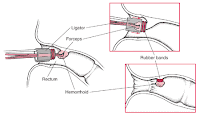 Hemmroid banding Hemmroid banding is a procedure recommended for those whose hemmroids are located in the rectum or the anus and for those who have sever bleeding, pain or if the hemmroid contains a blood clot. But this banding procedure is not for those whose prolapsed hemmroid hangs on the outside of the body. Hemmroid banding is used to treat painful, swollen hemmroids. And more than one hemmroid can be banded at the same time. This hemmroid banding is most often performed for the following reasons: - • Severely bleeding hemmroids
- • Severely painful hemmroids
- • Hemmroid containing a blood clot (called thrombosed hemmroid)
- • Hemmroids that protrude through the anus (called prolapsed hemmroids)
Hemmroid banding is done using local anesthesia, and you are considered an in and out patient because it is one of those same day surgery procedures; A procedure that involves a doctor inserting an instrument with a light and lens, called an anoscope, through the anus, which is held in position by an assistant. This instrument will allow the doctor to locate and see the hemmroid problem. Once the hemmroid is located, the doctor uses a special banding tool to place a small rubber band around the hemmroid. And this procedure will cause the hemmroid to shrink because this hemmroid banding cuts off the blood supply to the hemmroid. The rubber band stays in place for 1-2 weeks until the hemmroid falls off. It usually appears to be that the only way to be rid of hemmroids is to go through more pain and suffering by procedures that claim to eliminate the pain, bleeding, and swelling once and for all; snip, clip and tie and then your hemmroid issue will vanish forever. But it should not be at all cases. There are a lot of severe hemmroid condition that can only be treated with natural home remedies but because other hemmroid condition does not respond to natural treatments that’s why hemmroid banding is recommended even it cause you pain. The procedure of hemmroid banding is another method that will eliminate a hemmroid, but not without leaving you with a painful recovery period. As you can see, anything connected to hemmroid relief comes with a certain amount of suffering before and after; at least when you use the conventional methods of destroying the embarrassing problem. However, do not think that since the hemmroid is gone that your worries are over; you may find yourself back at the doctor's office for the same hemmroid issue, simply because the problem can return. All that pain and suffering repeated, letting you know that the procedure is just a temporary fix. Take not that with this particular hemmroid banding procedure, there is automatic discomfort during and after the banding treatment. This is a relatively quick procedure, but the length of time depends on how many hemmroids need treatment. Patients often report some discomfort during and after this hemmroid banding procedure. If you feel sharp or severe pain, tell the doctor immediately. Mild pain medication helps manage discomfort during recovery. These possible complications includes: - • Allergic or other adverse reaction to the local anesthetic (if used)
- • Difficulty passing stool due to scar tissue
- • Swelling and pain from remaining hemmroids
- • Recurrence of hemmroids
With hemmroid banding, after everything is over and done with, your doctor will tell you to avoid straining, bearing down when using the bathroom and holding your breath during your bowel movement to avoid complications and to promote fast recovery. Here are some postoperative care after your hemmroid banding procedure: - • Expect some bleeding and discomfort.
- • Take sitz baths as recommended. Sitz baths will help relieve discomfort and clean the area. For a sitz bath, sit in warm water for 10-15 minutes. Pat the area dry, do not wipe or rub vigorously. You may be advised to take a sitz bath every four hours and after every bowel movement. Devices are available to place on top of the toilet to make this process easier.
- • For a few days, you may have difficulty controlling passage of gas and bowel movements.
- • Use a stool softener, exercise, drink plenty of fluids, and eat plenty of high-fiber foods (fruits, vegetables, beans, and whole grains) to prevent constipation and straining during bowel movements.
- • Move your bowels as soon as you feel the urge.
- • Do not sit on the toilet for long periods of time.
- • Apply hemmroid creams or ointments as directed by your doctor.
- • Avoid heavy lifting for two or three weeks.
Also do not hesitate to call your doctor if any of the following occurs after your hemmroid banding: - • Passing large amounts of blood
- • Pain becomes more severe
- • An aching feeling develops in the perineal area, between the rectum and the genitals
- • Signs of infection, including fever and chills
- • Constipation or difficulty urinating
Lastly, with all the hardship you encounter during and after your hemmroid banding, still many people may continue to develop new hemmroids after the banding procedure. What is better advise is really to treat your hemmorhoid as soon as possible before its too late. Not only with hemmroid banding but also with other surgical treatment . All hemmroid surgical procedure will not give you 100% completely healed condition without recur. Therefore, at first glance of hemmroid symptoms, immediately seek for doctors advise. Yet, still prevention is better than cure.
Posted in
Bleeding Hemmroids,
external hemmroids,
hemmroid causes,
Hemmroid Relief,
hemmroid surgery,
Hemmroid Symptoms,
thrombosed hemmroids
|
0 Comments »
 Thrombosed hemmroid Thrombosed hemmroid is among the most severe forms of hemmroids and is common to most ages 50 above. A thrombosed hemmroid is a hemmroid in which the vein has clotted . And hemmroid condition becomes worse because many don’t want to talk about it and they are ashamed to talk with their doctors as they do not realize that there is an easy treatment for thrombosed hemmroids, without having to endure painful hemmroid surgery. Before discussing an effective remedy for thrombosed hemmroids, we should know first what hemmroids are, what its causes and symptoms and what causes a hemmroid to become thrombosed. The best way to describe hemmroids is to think of them as varicose veins but inside and outside of the rectum area and they occur due to the same reasons, strain; in the case of hemmroids strain during bowel movement such as in the case of diarrhea or constipation but also during pregnancy, anal intercourse or am existing medical condition. Thrombosed hemmroid is swollen veins of the anus which protrude and is external. When blood flow becomes restricted to the area, a clot can form which causes thrombosed hemmroids. Although thrombosed hemmroid is normally surpassingly disquieting they do not commonly require surgical removal. This hemmroid can occur inside the anal canal or as external hemmroids and they vary in size from being very small (the size of a pea) through to being as spacious as a golf ball in the most extreme cases. I nternal thrombosed hemmroid cannot be seen or felt with ease unless they prolapsed and protrude towards the outside of the rectum but some visible symptoms are bright colored, fresh blood in the stool or toilet paper so, if you have been straining lately during bowel movement or have some doubts that you may have internal thrombosed hemmroids look out for those symptoms. External thrombosed hemmroids can be seen, felt on touch and also experience the following: itching, burning and pain along with bleeding in the stool, on the toilet bowl and/or toilet paper. Common causes for hemmroids are: Sitting in one position for too long, forcing during a bowel movement, weight lifting and childbirth. Thrombosed hemmroid can be extremely uncomfortable and can cause symptoms from discomfort and itching, to burning and extreme pain. Many over the counter hemmroid creams and ointments do not work properly, and most medicines for hemmroids do not actually get rid of the condition, but just provide relief. A successful hemmroids treatment will provide relief as well as completely eliminate the condition, without surgery. After consulting your doctor to ensure that you have thrombosed hemmroids you will be offered the following choice of hemmroid treatment: to drain the blood or to remove them by surgery depending on your case. But for fast relief from itching, burning and pain try medicated wipes that can be bought over the counter in drug stores as well as hemmroid creams and ointments for long lasting relief during the night or when at work. Natural remedies can also make a big difference to sufferers of thrombosed hemmroid; in fact, when natural cures are used correctly they can fully cure thrombosed hemmroids. Below we have listed some useful tips to relieve thrombosed hemmroid pain: - Take several warm baths in a sitting position . This disposition reduce pain and unblemished the affected area. But sitting down can often be very uncomfortable for sufferers of thrombosed hemmroid, in this case try squatting in the warm water for 5 minutes or so.
- Avoid straining when removing the stool ” admitting that you struggle when going to the toilet, we recommend making your stools softer. This can be done by eating foods with supercilious levels of natural fibers such as fruits and vegetables, bran, beans etc to add bulk to your stool thus avoiding extra pain to your thrombosed hemmroid.
- Avoid dehydration. Stay hydrated by the agency of intemperate habits a minimum of 7 glasses of water daily. This is not difficult - you should scope for 10 glasses to ensure hydration. Try toping 2 glasses proximately when you wake up in the morning, 2 more at peep of day tea time and lunch time, 2 at dinner time and 2 before going to bed. Its always better to sip the water than drink it quickly.
- Apply ice to the anal opening (or affected area). This will reduce the blood flow to the superficial contents and will also numb the thrombosed hemmroid. Wrap ice in a cloth to apply .
- As a very temporary solution to excruciating hemmroid pain ” Ibuprofen have power to be same effective.
- Use a hemmroid cream which can be most at most pharmacy's and chemists to reduce wrath. But remember that hemmroid creams work differently for different people and it does not provide long term solutions to your thrombosed hemmroid.
- Increase your rate of metabolism by dint of walking for 20 minutes a day. This is probably best done after having a sitz bath or when you feel the least pain.
- Reduce irritation and pain when cleaning your anus by using unusual delicate toilet paper or a soft damp towel. Try to avoid perfumed toilet pads as they can add irritation to your thrombosed hemmroid.
However, if you have tried everything including natural cures and still havent got results, its highly recommended to seek for doctors advise if there a need for you to have surgery to remove the hemmroid which includes thrombosed type of hemmroid. A few of your options include:
- Rubber-band Ligation ” this technique is performed by placing a rubber-band around the hemmroid which causes it to dry up and eventually disappear.
- Hemmroidectomy ” this procedure is reserved for only the most severe cases of piles due to the long painful recovery time which is needed.
- Sclerotherapy ” the infected area is injected by a shrinking agent. The hemmroid eventually disappears.
Preventing thrombosed hemmroid altogether is a challenge and you can do so by ensuring you eat a balanced diet with enough fiber for your type of metabolism, weight, age and present state of health that can only be decided by your doctor. Learning to understand and feel your body will also help greatly in recognizing symptoms when hemmroid appears, which are essential in order to start a hemmroid treatment as soon as possible.
As mentioned above, surgery should be considered to be unexhausted resort for removing thrombosed hemmroid, because in vast majority of cases thrombosed hemmroid can be cure using simple natural techniques. Or try asking your doctor for right and appropriate treatment for your thrombosed hemmroid. Take note hemmroids are fully treatable and not a fatal disease unless left untreated for long periods of time when diseases such as cancer can develop from it.
Posted in
Bleeding Hemmroids,
hemmroid causes,
hemmroid cure,
hemmroid surgery,
Hemmroid Symptoms,
Hemmroid Treatment,
Hemmroids Diagnosis/Test,
thrombosed hemmroids
|
0 Comments »
 Hemmroid treatments Hemmroid treatments can give quick and effective relief from discomfort and other problems associated with hemmroid when acted as early as its symptoms appear. There are now various prescription drugs as well as over-the-counter medicines available currently for hemmroid treatment. There are also alternative therapies for hemmroid treatment that can give you safe and long lasting results which includes homoeopathic and herbal medicines, dietary supplements and home made remedies . So there is no reason why you cannot treat your hemmroid before it becomes worst. But what is hemmroid by the way? Hemmroids are the network of veins around the anus area. The condition known as hemmroids occurs when these veins enlarge and distend usually caused by straining or pressure. The two types of hemmroids are internal and external. Internal hemmroids usually do not cause much pain and rarely itch while external hemmroids are the type of hemmroid that tends to cause burning, itching, and/or pain. Symptoms of hemmroid usually include blood in the stool, in the toilet, or on bath tissue after using the bathroom, or a vague pain in the anus after defecating. Also, itching, burning, or pain in the region may indicate a case of hemmroids. Because of this irritating symptoms brought by hemmroid, appropriate hemmroid treatments are necessary. But most commonly, hemmroid treatments may require nothing more than home treatment and lifestyle changes, which mainly involves establishing healthy bowel habits and simple changes to healthy diet. But if you need instant relief from pain, itching and swelling brought by your hemmroid, try the following: - Apply a hemmroidal cream or suppository to the affected area as directed.
- Use ice packs, which can reduce swelling from painful hemmroid.
- Soak in a warm bath or "sitz" bath (sitting in three inches of water) for 10 minutes a few times a day.
You can talk to your doctor about your hemmroids and ask for any hemmroid treatment during your next visit. And to encourage better bowel movements, your doctor may suggest some initial lifestyle changes, such as increasing your fiber and fluid intake and exercise. If these changes do not help; your doctor may suggest one of the following types of hemmroid treatment: Fiber is the part of a plant that can't be digested. It adds bulk to keep other foods moving through the digestive system and it holds water which, in turn, softens the stool for easy elimination. Fiber laxative and stool softeners should be used only as directed. And take note that different hemmroid treatments work in different ways so let your doctor choose the best one for you. Although in many cases hemmroid treatment involves steps that you can take on your own but sometimes medications or surgical procedures are necessary as your best way as your hemmroid treatment. These includes: Medications CReamsIf your hemmroids are producing only mild discomfort, your doctor may suggest over-the-counter hemmroid creams, ointments or pads containing witch hazel or a topical anti-inflammatory agent containing hydrocortisone. This local hemmroid treatment, in combination with daily warm baths, may relieve your hemmroid symptoms. Surgical or other proceduresIf a blood clot has formed within an external hemmroid, your doctor can easily remove the clot with a simple incision, which may provide prompt relief. But for persistent bleeding or painful hemmroids, your doctor may recommend these following hemmroid treatments: - Rubber band ligation. Your doctor places one or two tiny rubber bands around the base of an internal hemmroid to cut off its blood circulation and the hemmroid falls off. This simple procedure - called rubber band ligation - is done in the doctor's office and is effective hemmroid treatment for many people. To remove a hemmroid using rubber band ligation, your doctor inserts the ligator through a scope in the anal canal, grasping the hemmroid with forceps. Sliding the ligator's cylinder upward releases rubber bands around the base of the hemmroid. Rubber bands cut off the hemmroid's blood supply, causing it to wither and drop off.
- Sclerotherapy. In this procedure, your doctor injects a chemical solution around the blood vessel to shrink the hemmroid.
- Infrared light. A one- or two-second burst of infrared light cuts off circulation to small, bleeding, internal hemmroids.
- Surgery. If other procedures haven't been successful or if you have large hemmroids, your doctor can remove tissue in a procedure called hemmroidectomy. The surgery is done with either a local anesthetic combined with sedation, a spinal anesthetic, or a general anesthetic. Hemmroid surgery can be performed on an outpatient basis or you may require an overnight hospital stay. While you may experience discomfort after the procedure, medications can be used to relieve your pain. Soaking in a warm bath also can ease your discomfort.
- Stapling. This procedure, which blocks blood flow to hemmroidal tissue, is a relatively new hemmroid treatment technique. While some experts point out that this procedure involves less pain than surgery and allows an earlier return to work, there are drawbacks as well. Stapling has been associated with a greater risk of hemmroidal recurrence and prolapse compared with open surgery. Talk with your doctor about what might be the best hemmroid treatment option for you.
You can also take the following steps to reduce your risk of having hemmroids thus avoiding unnecessary and time consuming hemmroid treatments. Try follow these easy steps: - Eat more fiber and drink plenty of fluids. This will help soften stools and promote regular elimination, which reduces straining thus avoiding the causes of such hemmroid.
- Go when you feel the urge to have a bowel movement. Delaying now can mean straining later.
- Don't read on the toilet. Sitting and straining too long encourages swelling.
- Wipe gently with soft, white unperfumed tissue. This helps keep the area clean to avoid irritation.
- Exercise regularly; which aids digestion and improves circulation.
Take note that complications of untreated hemmroid are - bleeding, infection, prolapse, strangulation, necrosis and gangrene. Painful bleeding usually indicates startup of complications. So do not delay. Let your hemmroid be treated as early as its symptoms shows. Don’t be shy if you have that condition. You just don’t know that the number of people who hemmroid are now increasing due to poor eating habits and changes of lifestyle. You cant talk with your family regarding your shameful condition, talk directly to your doctor as he can help you. Your doctor can give you right hemmroid treatment.
Posted in
Bleeding Hemmroids,
external hemmroids,
hemmroid causes,
hemmroid surgery,
Hemmroid Treatment,
Hemmroids Diagnosis/Test,
internal hemmroid
|
0 Comments »
 Exactly what causes hemmroids are unknown, but we do know that hemmroids are usually caused by increased pressure in the anus. The upright posture of humans alone forces a great deal of pressure on the anus, which sometimes makes them to bulge. Other causes of hemmroids includes:o Sitting in one place to often o Straining while moving bowels (from constipation or hard stools). This is the most common cause. o Excessive rubbing, or cleaning around the anus o Diarrhea o Sitting on the toilet too long o Severe coughing o Childbirth o Lifting heavy objects o Anal infection Other contributing factors that causes hemmroids are: o Aging o Chronic diarrhea or constipation o Pregnancy o Misfortune of Heredity o Frequent use of laxatives or enemas resulting in faulty bowel function o Straining during bowel movements o Too much reading on the toilet Whatever the causes of hemmroids, the bottom line is the tissues are stretched. As a result, the veins dilate; and the vein walls become thin and bleed. If the pressure continues to stretch, they become weakened and protrude out of the anus. Hemmroids are also very common, especially during pregnancy and after childbirth Hemmroids are one of the most common ailments known. More than half the population will develop hemmroids, usually after age 30. The average person suffers in silence for a long period before seeking medical care. Today's hemmroid treatment methods make some types of hemmroid removal much less painful. Often described as "varicose veins of the anus and rectum", hemmroids are enlarged, bulging blood vessels in and about the anus and lower rectum. There are two types of hemmroids: external hemmroid and internal hemmroid, which refer to their location. o External (outside) hemmroids develop near the anus and are covered by very sensitive skin. These are usually painless. However, if a blood clot (thrombosis) develops in an external hemmroid, it becomes a painful, hard lump. The external hemmroid may bleed if it ruptures. o Internal (inside) hemmroids develop within the anus beneath the lining. Painless bleeding and protrusion during bowel movements are the most common internal hemmroid symptom. However, an internal hemmroid can cause severe pain if it is completely "prolapsed" protrudes from the anal opening and cannot be pushed back inside. What are Hemmroids SymptomsIf you notice any of the following, you could have hemmroids: • Bleeding during bowel movements • Protrusion during bowel movements • Itching in the anal area • Pain • Sensitive lump(s) Hemmroid Treatment
Mild symptoms can be relieved frequently by increasing the amount of fiber and fluids in the diet. Eliminating excessive straining reduces the pressure on hemmroids and helps prevent them from protruding. However, probably 95% of patients with hemmroid trouble can be treated without hemmroid surgery. The principles of non-operative treatment of hemmroids are: • A high fiber diet or taking a fiber supplement • Having soft, formed bowel movements • Avoid sitting on the toilet beyond the time needed for each bowel movement (Do not read or watch TV on the toilet. If you did not really need to go or are not sure if you’re done, get up and come back if needed) • Use baby wipes instead of toilet paper if you have pain, itching or irritation • A sitz bath - sitting in plain warm water for about 10 minutes - can also provide some relief . With these measures, the pain and swelling of most symptomatic hameriods will decrease in two to seven days, and the firm lump should recede within four to six weeks. In cases of severe or persistent pain from a thrombosed hemmroid, your physician may elect to remove the hemmroid containing the clot with a small incision. Performed under local anesthesia as an outtpatient, this procedure generally provides relief. Severe hemmroids may require special treatment, much of which can be performed on an outpatient basis. • Ligation – the rubber band treatment - works effectively on internal hemmroids that protrude with bowel movements. A small rubber band is placed over the hemmroid, cutting off its blood supply. The hemmroid and the band fall off in a few days and the wound usually heals in a week or two. This procedure sometimes produces mild discomfort and bleeding and may need to be repeated for a full effect. • I njection and Coagulation can also be used on bleeding hemmroids that do not protrude. Both methods are relatively painless and cause the hemmroid to shrivel up. • Hemmroid stapling – this is a technique that uses a special device to internally staple and excise internal hemmroidal tissue. The stapling method may lead to shrinkage of but does not remove external hemmroids. This procedure is generally more painful that rubber band ligation and less painful than hemorroidectomy. • Hemmroidectomy – surgery to remove the hemmroids - is the most complete method for removal of internal and external hemmroids. It is necessary when (1) clots repeatedly form in external hemmroids; (2) ligation fails to treat internal hemmroids; (3) the protruding hemeoriods cannot be reduced; or (4) there is persistent bleeding. A hemmroidectomy removes excessive tissue that causes the bleeding and protrusion. It is done under anesthesia using either sutures or staplers, and may, depending upon circumstances, require hospitalization and a period of inactivity. Laser hemmroidectomies do not offer any advantage over standard operative techniques. They are also quite expensive, and contrary to popular belief, are no less painful. And in order for your hemeroid to keep it from coming back, you should try to avoid what causes of your hemmriods. But you should have to consult your doctor if hemmroid conditions becomes worse.
Posted in
hemmroid causes,
Hemmroid Symptoms,
Hemmroid Treatment,
Internal Hemmroids
|
0 Comments »
|
 How to cure hemmroids is the basic question for those who suffer from hemmroids . It is because having hemmroids causes a lot of distracting symptoms. Although it is impossible to cure hemmroid completely in just one try , foods and natural products are best medicine to cure hemmroids. Fruits and juices are there to cure hemmroids partially. Juices, which give best effect to cure hemmroids, like carrot and spinach juice, apple juice, and celery juice. But some of foods should be avoided to heal hemmroids are starch content, sugar content foods, chilly or spice foods. Vitamins also give good results to cure hemmroids.


