 How to treat hemmroids How to treat hemmroids? Well, treating hemmroids by simple treatment in an early stage is quite achievable than hemmroids that is already in worst condition. How to treat hemmroids is commonly asked especially for people who do not want to go to doctors for check up because they are ashamed of their condition. True that its is sometimes an embarrassing topic for discussion, but hemmroids are common. By age 50, about half of adults deal with the itching, bleeding and pain that often signal the presence of hemmroid. Hemmroids, are swollen and inflamed veins in your anus and rectum. They may result from straining when having a bowel movement or the increased pressure on these veins during pregnancy. Fortunately, effective hemmroid medications and procedures are readily available to treat hemmroids. And in many cases this condition may require only self-care and simple lifestyle changes. So, how to treat hemmroids?Treatment for this problem consists of two important parts: (1) what you can do, and (2) what your doctor can do... What Can You Do? How to treat hemmroids on your own? Well, you can temporarily relieve the mild pain, swelling and inflammation of most hemmroidal flare-ups with the following self-care measures: - * Put an ice bag on your hemmroids to help relieve acute pain. Some people find that the tanic acid from a warm, wet tea bag applied to the area is soothing. Others use compresses containing witch hazel applied to your hemmroid for 10 to 15 minutes three or four times a day.
- * A 10 to 15 minute soak in a warm bath three or four times a day may relieve hemmroid pain and swelling for some people.
- * Lying on your stomach or side instead of sitting may lessen the discomfort brought by hemmroids.
- * If you must sit try using a “donut pillow”. This will help take some of the direct pressure off on your hemmroids.
- * Keep the rectal area clean to help relieve the itching.
- * Do not wipe yourself vigorously. Patting with toilet paper will help. Using moistened toilet paper or baby-wipes after a bowel movement can protect the skin from further hemmroids irritation.
- * Avoid scratching. This will make your hemmroids worse.
- * Avoid anti-itching creams or lotions with an ingredient that has "-caine" in its name. These products have a local anesthetic in them and, if used too often, can cause further hemmroid irritation.
- * Use topical treatments. Apply an over-the-counter hemmroid cream or suppository containing hydrocortisone, or use pads containing witch hazel or a topical numbing agent.
- * It is recommended that you consult with a physician prior to using any suppository-type product. Or better, try hemmroid creams than suppositories.
- * Keep the anal area clean. Bathe or shower daily to cleanse the skin around your anus gently with warm water. Soap isn't necessary and may only aggravate your hemmroids. Gently drying the area with a hair dryer after bathing can minimize moisture, which can cause hemmroid irritation.
- * Push back a prolapsed hemmroid. If a hemmroid has prolapsed, gently try pushing the hemmroid back into the anal canal.
- * Don't use dry toilet paper. Use moist towelettes or wet toilet paper after a bowel movement instead.
- * Take oral medications. Acetaminophen (Tylenol, others), aspirin or ibuprofen (Advil, Motrin, others) may relieve your discomfort brought by hemmroids.
What Can Your Doctor Do ToTreat Hemmroids• Your doctor will examine your rectal area and may recommend several alternatives on hoe to treat hemmroids. Prescription of hemmroid creams and suppositories are available for hemmroid pain and swelling. • Your doctor may also recommend a stool softener or a high-fiber, anti-constipation diet. All of these are available over the counter. The dietary fiber should be between 20 and 35 grams a day. • If hemmroids persist or are particularly troublesome, a more active type of hemmroid treatment may be necessary. This may include the following: - Banding hemmroids. This is how to treat hemmroids through banding. Your doctor places one or two tiny rubber bands around the base of an internal hemmroid to cut off its circulation and the hemmroid falls off. This simple procedure — called rubber band ligation — is done in the doctor's office and is effective for many people.
- Sclerotherapy. A chemical solution is injected around the blood vessel to shrink the hemmroid.
- Infrared light. A 1- or 2-second burst of infrared light can cut off circulation to small, bleeding, internal hemmroids.
- Surgery. If other procedures haven't been successful or if you have large hemmroids, your doctor can remove tissue in a procedure called hemmroidectomy. The surgery is done with either local anesthetic combined with sedation, a spinal anesthetic, or general anesthetic. It's usually done as an outpatient or overnight hospital stay. While you may experience discomfort after the procedure, medications can be used to relieve your pain. Soaking in a warm bath can also ease your discomfort. Some newer surgical techniques may decrease the amount of pain that some people experience.
Take note also that as a general rule, see your doctor if your hemmroids don't improve with self-care, cause pain, or bleed frequently or excessively. If the onset of your hemmroids occurs along with a marked change in bowel habits or if you're passing black, tarry or maroon stools, consult your doctor without delay. These types of stools can signal more extensive bleeding elsewhere in your digestive tract. Also seek emergency care if you notice large amounts of rectal bleeding, lightheadedness, dizziness or faintness. The most common sign of hemmroids is rectal bleeding. But because rectal bleeding can occur for other reasons, see your doctor to rule out more serious conditions or diseases. Other causes of bleeding in the lower gastrointestinal tract include colorectal or anal cancer. A doctor may also determine if you have external hemmroids simply by looking. For internal hemmroids, your doctor may want to conduct an examination with a rubber-gloved finger. But even this technique may be inconclusive because internal hemmroids are often too soft to detect by a rectal examination. In this case your doctor may want to examine the lower portion of your colon and rectum with an anoscope, proctoscope or sigmoidoscope. A more extensive examination could include an examination of the entire colon and rectum using a flexible fiber-optic colonoscope, to help exclude bleeding lesions not only in the rectum but also in the entire colon. Close follow-up is necessary, however, and continued bleeding despite hemmroid treatment requires additional examinations. So, how to prevent hemmroids formation or to prevent hemmroids from coming back? These as follows: - Eat high-fiber foods. Eat more fruits, vegetables and grains. Doing so softens the stool and increases its bulk, which will help lessen the straining that can cause hemmroids.
- Drink plenty of liquids. This can help avoid constipation as very common cause of hemmroids. But the exact amount of water and other fluids you should drink each day varies and depends on your age, sex, health, activity level and other factors.
- Consider fiber supplements. Over-the-counter products such as Metamucil and Citrucel can help keep stools soft and regular. Check with your doctor about using stool softeners. If you use fiber supplements, be sure to drink at least eight to 10 glasses of water or other fluids every day. Otherwise, fiber supplements can cause constipation or make constipation worse. Add fiber to your diet slowly to avoid problems with gas.
- Exercise. Stay active to reduce pressure on veins, which can occur with long periods of standing or sitting, and to help prevent constipation. Exercise can also help you lose excess weight thus avoiding possible causes of hemmroids.
- Avoid long periods of standing or sitting. If you must sit for long periods, don't use an inflatable doughnut cushion to pad your chair. It can increase the pressure on the veins in the anus.
- Don't strain. Straining and holding your breath when trying to pass a stool creates greater pressure in the veins in the lower rectum. This is what you should do while on your pprocess of treating your hemmroids.
- Go as soon as you feel the urge. If you wait to pass a bowel movement and the urge goes away, your stool could become dry and be harder to pass resulting to exerting much pressure which causes formation of hemmroids.
The mention above are the following suggestion on how to treat hemmroids. Just choose what best suit for your condition. And remember, notify your doctor if you have any of the following symptoms: Severe, acute bleeding that you cannot control, bleeding that lasts more than a week , and severe hemmroid pain lasting more than a few hours.
Posted in
Bleeding Hemmroids,
hemmroid removal,
hemmroid surgery,
Hemmroid Symptoms,
Hemmroid Treatment,
internal hemmroid
|
0 Comments »
 Hemmroid doctor Hemmroid doctor, is the one who works with hemmroids, among other things. They are hemmroid specialist called proctologist. In point of fact, proctologists deal with the entire colon and anorectal canal, which pretty much covers the entire large intestine. When dealing with hemmroids, proctologists are the specialists to see first. Since more than half of the population will, at some time, suffer from hemmroids, there is a great need for specialists in this area as hemmroid doctor. Patients with this condition generally find that visiting and consulting to doctors specializing in the care of hemmroids is very beneficial, since their area of practice is so focused. You'll have access to all of the latest hemmroid treatments and techniques, and you can be assured that your hemmroid doctor knows all of the latest information that can help relieve your suffering. Hemmroids fall into a pretty rare medical category in that they are usually not serious but, at the same time, can be occasionally quite complicated to treat. Some of the surgical procedures can even require a specialized surgeon to perform. Always take note that a good hemmroid doctor will always give hemmroids the time and attention they deserve, rather than brushing them off as "simple". The hemmroid itself is not much of a problem, but the area of the body hemmroids reside in is quite complicated and needs care and detailed attention in order to work properly. Improperly performed surgery can cause lasting damage to the anal area, which can severely impact quality of life The first hemmroid doctor you'll want to see about your hemmroids will be your family doctor, who should already be quite familiar with you and your medical history. A general practitioner with whom you have a good working relationship is invaluable when dealing with any health condition, and doubly so when it comes to hemmroids. Make an appointmentwith your hemmroid doctor to explain and discuss all of your hemmroid symptoms in detail to date. When hemmroids are uncomplicated by bleeding, thrombosis or extreme prolapse, your hemmroid doctor will probably tell you that the hemmroids will be best treated at home. Your hemmroid doctor will also probably give you recommendations for home treatment to include a high-fiber diet, warm water sitz baths, and any other techniques he or she knows of. For further hemmroid relief, the doctor may also give you a prescription for a painkiller in either cream or tablet form. On the other hand, if you do have any of the complications listed above your family doctor will probably refer to a proctologist, which is a specialist who deals specifically with the colorectal/anal area. This is one key hemmroid doctors to be aware of. If your family doctor wants to refer you to a proctologist, do be sure to communicate what's important to you in a doctor who'll be examining such a private and delicate area. While your family doctor may not have the exact education to deal with complicated hemmroids, he or she does know both you and the various specialists in the area. This makes your family doctor the best qualified person to both find a good hemmroid doctor for you and to be your advocate during the continuation of your hemmroids treatment. These " Hemmroid Doctors" specialize in specific treatments for this condition. Since there are currently many methods for treating hemmroids, these doctors will be able to prescribe which one will be the most effective for your particular case. Most hemmroid doctors will start with conservative hemmroid treatments initially and then move to more serious techniques if the hemmroids do not respond to treatment. While most hemmroids are caused infrequently by excess straining or pressure on the anus, there are those that suffer from hemmroids on a chronic basis. This can be very uncomfortable and traditional treatment methods, such as over the counter ointments may not bring enough relief. For these patients, it is usually recommended that they undergo a procedure that will actually remove the hemmroid. See your doctor if the symptoms last longer than a week because your hemmroid doctor can determine which hemmroid treatment procedures are best for you. You should also see your doctor if you have bleeding, to ensure that there is not some other cause. Your doctor will examine your anus, feel inside the anal canal and may also insert a small metal tube, called a proctoscope, an inch or two into the anal canal to give a better view. For more information, look at the section on seeing your doctor about an anal problem. First- and second- degree hemmroid usually go away on their own if constipation is avoided, but your hemmroid doctor may prescribe a short course of hemmroid cream to relieve symptoms. Third-degree hemmroid may also go away on their own, but if they persist, they may need hospital treatment. Generally, only a few people need an hemmroid operation because most hemmroids are treated by natural home remedies, hemmroid treatment just like banding or phenol injections. There is usually no need for a general anesthetic or to stay in hospital overnight for these procedures. Stretching (anal dilatation) was a popular treatment in the 1970s, but is seldom used now. Most common hemmroid treatment are: Banding involves placing a small rubber band at the base of the hemmroid, so that it pinches the lining of the anal canal. This ‘strangles’ the hemmroid, so it dies and falls off. It causes some scarring. It is more effective than the other hemmroid treatments but has some drawbacks, such as severe bleeding in a few cases. Therefore you need to tell the surgeon if you are on blood-thinning medication. Some people feel faint and nauseous just after the bands are put on, and they can be quite painful for the following 48 hours. According to an article in the British Medical Journal(2003;327:8847–521), the success rate for hemmroid banding is: - • 79% of hemmroids are cured
- • 18% of hemmroid return so that repeat banding is needed
- • for 2% of hemmroid, it does not work at all.
Injection of phenol in almond oil is a method of causing scarring in the area, but produces a permanent cure in only about 25% of cases. It is less commonly used now, because the results are not as good as with banding. Cryosurgery freezes the hemmroid to destroy it. It is not used much, because it causes a watery discharge afterwards. Infrared coagulation uses infrared light to destroy the hemmroid. This method is not commonly used, because it is not as effective as other hemmroid treatment methods. However, if your hemmroid doctor believes that your hemmroids require surgery, ask for a lengthy and detailed polite conversation for the doctor to explain his or her reasons. The doctor should be able to convince you that this is the best option before you sign off on it. Be aware also that doctors can fire uncooperative patients. If your hemmroid doctor has made a reasonable effort to convince you and your doctor is right according to mainstream medicine, he or she may refuse to see you again. If your hemmroid doctor should go this far, it may be difficult to find a family doctor in the future, as other doctors don't want to take a risk on accepting a patient who won't listen. For this reason, it is important to maintain open channels of communication, to always be polite and civil, and to make sure that any doctor you are considering is open to your priorities, such as natural hemmroid remedies, before entering that doctor's care.
Posted in
Bleeding Hemmroids,
Hemmroid Banding,
hemmroid causes,
hemmroid cure,
Hemmroid Relief,
Hemmroid Symptoms,
Hemmroids Diagnosis/Test,
internal hemmroid,
thrombosed hemmroids
|
0 Comments »
 Hemmroid treatments Hemmroid treatments can give quick and effective relief from discomfort and other problems associated with hemmroid when acted as early as its symptoms appear. There are now various prescription drugs as well as over-the-counter medicines available currently for hemmroid treatment. There are also alternative therapies for hemmroid treatment that can give you safe and long lasting results which includes homoeopathic and herbal medicines, dietary supplements and home made remedies . So there is no reason why you cannot treat your hemmroid before it becomes worst. But what is hemmroid by the way? Hemmroids are the network of veins around the anus area. The condition known as hemmroids occurs when these veins enlarge and distend usually caused by straining or pressure. The two types of hemmroids are internal and external. Internal hemmroids usually do not cause much pain and rarely itch while external hemmroids are the type of hemmroid that tends to cause burning, itching, and/or pain. Symptoms of hemmroid usually include blood in the stool, in the toilet, or on bath tissue after using the bathroom, or a vague pain in the anus after defecating. Also, itching, burning, or pain in the region may indicate a case of hemmroids. Because of this irritating symptoms brought by hemmroid, appropriate hemmroid treatments are necessary. But most commonly, hemmroid treatments may require nothing more than home treatment and lifestyle changes, which mainly involves establishing healthy bowel habits and simple changes to healthy diet. But if you need instant relief from pain, itching and swelling brought by your hemmroid, try the following: - Apply a hemmroidal cream or suppository to the affected area as directed.
- Use ice packs, which can reduce swelling from painful hemmroid.
- Soak in a warm bath or "sitz" bath (sitting in three inches of water) for 10 minutes a few times a day.
You can talk to your doctor about your hemmroids and ask for any hemmroid treatment during your next visit. And to encourage better bowel movements, your doctor may suggest some initial lifestyle changes, such as increasing your fiber and fluid intake and exercise. If these changes do not help; your doctor may suggest one of the following types of hemmroid treatment: Fiber is the part of a plant that can't be digested. It adds bulk to keep other foods moving through the digestive system and it holds water which, in turn, softens the stool for easy elimination. Fiber laxative and stool softeners should be used only as directed. And take note that different hemmroid treatments work in different ways so let your doctor choose the best one for you. Although in many cases hemmroid treatment involves steps that you can take on your own but sometimes medications or surgical procedures are necessary as your best way as your hemmroid treatment. These includes: Medications CReamsIf your hemmroids are producing only mild discomfort, your doctor may suggest over-the-counter hemmroid creams, ointments or pads containing witch hazel or a topical anti-inflammatory agent containing hydrocortisone. This local hemmroid treatment, in combination with daily warm baths, may relieve your hemmroid symptoms. Surgical or other proceduresIf a blood clot has formed within an external hemmroid, your doctor can easily remove the clot with a simple incision, which may provide prompt relief. But for persistent bleeding or painful hemmroids, your doctor may recommend these following hemmroid treatments: - Rubber band ligation. Your doctor places one or two tiny rubber bands around the base of an internal hemmroid to cut off its blood circulation and the hemmroid falls off. This simple procedure - called rubber band ligation - is done in the doctor's office and is effective hemmroid treatment for many people. To remove a hemmroid using rubber band ligation, your doctor inserts the ligator through a scope in the anal canal, grasping the hemmroid with forceps. Sliding the ligator's cylinder upward releases rubber bands around the base of the hemmroid. Rubber bands cut off the hemmroid's blood supply, causing it to wither and drop off.
- Sclerotherapy. In this procedure, your doctor injects a chemical solution around the blood vessel to shrink the hemmroid.
- Infrared light. A one- or two-second burst of infrared light cuts off circulation to small, bleeding, internal hemmroids.
- Surgery. If other procedures haven't been successful or if you have large hemmroids, your doctor can remove tissue in a procedure called hemmroidectomy. The surgery is done with either a local anesthetic combined with sedation, a spinal anesthetic, or a general anesthetic. Hemmroid surgery can be performed on an outpatient basis or you may require an overnight hospital stay. While you may experience discomfort after the procedure, medications can be used to relieve your pain. Soaking in a warm bath also can ease your discomfort.
- Stapling. This procedure, which blocks blood flow to hemmroidal tissue, is a relatively new hemmroid treatment technique. While some experts point out that this procedure involves less pain than surgery and allows an earlier return to work, there are drawbacks as well. Stapling has been associated with a greater risk of hemmroidal recurrence and prolapse compared with open surgery. Talk with your doctor about what might be the best hemmroid treatment option for you.
You can also take the following steps to reduce your risk of having hemmroids thus avoiding unnecessary and time consuming hemmroid treatments. Try follow these easy steps: - Eat more fiber and drink plenty of fluids. This will help soften stools and promote regular elimination, which reduces straining thus avoiding the causes of such hemmroid.
- Go when you feel the urge to have a bowel movement. Delaying now can mean straining later.
- Don't read on the toilet. Sitting and straining too long encourages swelling.
- Wipe gently with soft, white unperfumed tissue. This helps keep the area clean to avoid irritation.
- Exercise regularly; which aids digestion and improves circulation.
Take note that complications of untreated hemmroid are - bleeding, infection, prolapse, strangulation, necrosis and gangrene. Painful bleeding usually indicates startup of complications. So do not delay. Let your hemmroid be treated as early as its symptoms shows. Don’t be shy if you have that condition. You just don’t know that the number of people who hemmroid are now increasing due to poor eating habits and changes of lifestyle. You cant talk with your family regarding your shameful condition, talk directly to your doctor as he can help you. Your doctor can give you right hemmroid treatment.
Posted in
Bleeding Hemmroids,
external hemmroids,
hemmroid causes,
hemmroid surgery,
Hemmroid Treatment,
Hemmroids Diagnosis/Test,
internal hemmroid
|
0 Comments »
 Hemmroid removal Hemmroid removal is only recommended when your hemmroid is already in severe stage. Hemmroid removal is performed via the standard form of hemmroids surgery called Hemmroidectomy. This type of hemmroid surgery is performed in cases of large internal hemmroids, large external hemmroids, and hemmroids that have not been treated effectively by other methods. Although most hemmroids are treated by medicines and other different remedies to provide relief from the disturbing symptoms of pain and inflammation caused by the affected rectal tissues, severe cases of the hemmroids requires hemmroid removal if you want long-term hemmroid relief. Hemmroids are mostly affected to the people who are all above 30 years of age. Many treatments and methods are there for hemmroid removal without having any pain. There are two types of hemmroids like external hemmroids and internal hemmroids. But external hemmroid removal is done by surgery. For Internal hemmroid removal, those are small and some large it is then treated by non-surgical or home treatments. If the internal hemmroid is very large then some treatments like laser therapy, sclerotherapy, are used for internal hemmroids removal. Laser therapy used in internal hemmroid removal is painless; in this treatment hameriods are burned. Surgical hemmroid removal, also know as hemmoroidectomy, it is the most successful treatment for internal hemmroid removal. Some times both internal hemmroid and external hemmroid will be present for that, combination of surgical hemmroid removal and fixative procedure is used for hemmroid removal. Hemmroid removal is also done by herbal treatments, home made remedies. Herbal remedies for hemmroid removal is by using some herbal products which contain horse chestnut, barberry, neem, nagkesar and so on. But the best and easiest way for hemmroid removal is by the surgical only, other treatments for hemmroid removal are not so effective as surgical because it takes time to get cure of hemmroids. Nowadays every doctor will prescribed for surgical hemmroid removal. But surgical hemmroid removal is preferred only for those who have severe internal hemmroids or external hemmroids.Hemmroid removal by means of Hemmroidectomy is performed by giving the patient a long-acting local anesthesia, usually in a surgery center. The surgeon makes incisions in the tissues around the hemmroid-affected area by using a surgical knife (called ‘scalpel’), a cautery pencil (a device working by means of electricity), or a laser. Hemmroids removal is then performed after tying off the swollen veins to prevent bleeding. After completing the hemmroids removal, the surgical wounds may be covered with medicated gauze. The patient is usually able to go home the same day. The recovery time for most people undergoing hemmroids surgery is two to three weeks. Hemmroid removal via surgery is successful in over 90% of cases, which means that hemmroids do not ever return after the surgery. In about 5% of cases, the condition is reported to recur. The commonly reported risks associated with hemeriods surgery are pain, bleeding from the surgical wound, and difficulty in urinating. The latter may also result in edema. Other risks, less commonly associated with hemmroids removal, include: bleeding from the anal area, incontinence, difficulty in passing stool, and infection of the surgical wound. At a later stage, in some cases, narrowing of the anal area may occur, or the patient may develop a fistula i.e. an abnormal passage in the rectal/anal area. Care after Hemmroids Removal After removing hemmroids via surgery, the patient and the caregivers need to consider some points in order to make recovery quicker and complete. Feeling pain is normal after hemmroids surgery. To get relief from pain, the patient should use any prescribed medicine for pain relief. Bleeding from the anal area may occur after the surgery, especially during the first bowel movement. Ice packs may be applied to the operated area to relive inflammation. Also effective are warm water baths (sitz baths) for alleviating pain and muscle spasms. To prevent infection, the doctor may prescribe antibiotic drugs. Also recommended for most patients are fiber-rich diet and other remedies that soften the stools. These help in preventing straining during defecation, which may cause the recurrence of hemeoroids. In all cases, the patient is supposed to take follow-up exams with the surgeon after a week or so, as per surgeon’s advice. After the success of your hemmroid removal it is strongly advise then to take some hemmroid preventions to keep your hemmroid from coming back. The best way to prevent hemmroids is to keep stools soft so they pass easily, thus decreasing pressure and straining, and to empty bowels as soon as possible after the urge occurs. Exercise, including walking, and increased fiber in the diet help reduce constipation and straining by producing stools that are softer and easier to pass. All of these may help you avoid of having hemmroid removal again.
Posted in
Bleeding Hemmroids,
hemmroid surgery,
Hemmroid Symptoms,
internal hemmroid
|
1 Comments »
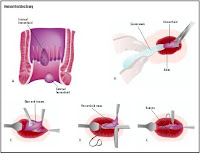 Hemmroid surgery Hemmroid surgery, or hemmroidectomy, is a surgical procedure to remove hemmroids. Hemmroids occur when an increase of pressure in the veins around the anus and rectum causes them to become swollen and stretched. They may result from a number of factors such as straining during a bowel movement , pregnancy, prolong sitting, overweight, chonic constipation and a like. In hemmroid surgery, hemmroidal tissue and excess tissue around the anal canal is surgically removed (excised). The procedure is typically performed in a hospital or surgery center by a surgeon who specializes in colon and rectum surgeries. An overnight hospital stay is usually required, but in some cases the procedure may be performed on an outpatient basis. Hemmroidectomy is highly effective, but recovery is similar to recovery from other surgeries and may be initially painful. Hemmroidectomy is important in the treatment of extensive or severe hemmroids. It can be used in the treatment of both internal hemmroids and external hemmroids, as well as those that occur both internally and externally at the same time. It is not generally used for mild- to-moderate hemmroids. However, it may be used to treat less severe hemmroids if other treatment options (e.g., stool softeners, sitz baths) fail. Hemmroidectomy is also useful in the treatment of patients who have developed certain complications. Persistent bleeding may only be effectively treated with the removal of the hemmroids, although less severe bleeding can be treated with other therapies. When blood clots form inside hemmroids, the hemmroids must usually be removed. Recovery from hemmroidectomy generally takes between two and three weeks. The risk of hemmroid recurrence is much lower with hemmroidectomy than with other methods of hemmroid treatment. Pain and discomfort are common following hemmroid surgery and pain-relief medications are usually prescribed. After surgery, the rectal area is monitored for bleeding and laxatives are used to ease defecation. Fluid intake is also monitored. Any increased rectal bleeding, pus drainage, fever, constipation or rectal spasms need to be reported to a physician. It is important to prevent constipation following surgery. Therefore, patients may be encouraged to exercise, drink plenty of fluids and eat a high-fiber diet . Hemmroid surgery is the most effective treatment for hemmroids. However, it does pose potential risks. Urinary retention, urinary tract infections , fecal impaction and bleeding are the most common complications of the procedure. Alternatives to hemmroid surgery include many minimally invasive techniques, especially rubber band ligation and coagulation (e.g., infrared coagulation, electrocoagulation). New techniques for treating hemmroids are also being developed. Before hemmroid surgery, the physician will explain the procedure and answer any questions the patient may have. The patient will then be instructed to sign an informed consent form. The patient will typically be placed on a special, low-residue diet for several days prior to the surgery. A low-residue diet contains very few foods that can become caught in the colon. This helps keep the colon clean for the surgery. The patient’s hemmroids will be evaluated. External hemmroids will be examined, with particular attention to size, evidence of bleeding and the presence of drainage. Stool softeners and an enema may be used just before the surgery to prepare the bowels. The rectal area will then be cleansed. This may involve a sitz bath, in which the patient sits in a small amount of warm water. After it has been cleansed, the rectal area may be shaved. Hemmroid surgery procedureHemmroid surgery is performed with the patient under anesthesia. In most cases, a general or spinal anesthetic is used. General anesthetics cause a patient to lose consciousness and sensation by an injection of medication or breathing a medicinal gas. Spinal anesthetics cause a patient to lose sensation of pain by injecting a medication into the area around the spinal cord. Some patients may be able to tolerate a local anesthetic combined with sedation. This causes a loss of sensation in only a specific region of the body. When spinal anesthetics or local anesthetics are used, the patient remains conscious during the procedure. During hemmroid surgery, an anoscope is used to view the hemmroid and surrounding tissue. An anoscope is a short, rigid tube that is inserted into the anus. Once the surgeon can see the base of the hemmroid, its blood supply is tied off with surgical stitches (sutures). The hemmroidal tissue is removed, or excised, and some of the surrounding tissue is usually removed as well. The surgeon takes care to avoid damaging the anal sphincter. The actual removal of tissue may be done with a scalpel, scissors, cautery (uses an instrument that relies on heat or electricity to cut tissue) or laser. The edges of the anal or rectal lining (rectal mucosa) around the excised tissue may be left open, closed or partially closed. This is a matter of physician preference. Results and post-surgical pain are similar whether the lining is left open or closed. After hemmroid surgeryLike with many surgical procedures, pain and discomfort are common following a hemmroid surgery. However, medications are prescribed to relieve the pain and Sitz baths may be used to relieve discomfort and promote healing. The patient’s vital signs are monitored regularly during the period immediately after the hemmroid surgery. The rectal area is monitored hourly for bleeding. Any excessive bleeding is treated. This may be accomplished by inserting a balloon-tipped catheter into the rectum. The balloon tip places pressure on the bleeding area, stopping the bleeding. Prescription ointments may be applied to the rectal area to help it heal and to relieve pain. Dressings, typically pads, are changed frequently. Stool softeners and bulk laxatives are prescribed to ease defecation. It is important to increase fluid intake while taking these medications. The patient’s fluid balance is monitored. Health care professionals will keep track of how much liquid the patient consumes and ensure that the patient urinates between eight to 12 hours after the surgery. Patients may be discharged following the hemmroid surgery or may need to remain in the hospital overnight. It is important for patients to change positions frequently after the procedure, and to lie down for about 15 minutes every hour. This helps to reduce rectal swelling. A special pad is typically given to the patient to ease discomfort when sitting. However, rubber rings are not recommended as they can block blood flow and cause swelling. Any increased rectal bleeding, pus drainage, fever, constipation, severe abdominal pain, rectal spasms, swelling, weakness or infection need to be reported to a physician. It is also important to keep the rectal area clean. The rectal area needs to be cleansed gently with warm water and mild soap. It should be rinsed thoroughly and gently patted dry. Patients are urged not to strain during a bowel movement. Constipation can be prevented with regular exercise and by drinking plenty of fluids and eating plenty of high-fiber foods (e.g., fruits, vegetables). Bulk laxatives may also be used as needed. However, overuse of stool softeners should be avoided. Firm stool is important to dilate the anal canal and prevent strictures (narrowing). Hemmroid benefits and risksHemmroid surgery ( hemmroidectomy) is the most effective treatment for hemmroids. It frequently eliminates hemmroids with no recurring symptoms. When symptoms do recur, they are rarely severe enough to require additional surgery. However, hemmroidectomy does pose certain risks. Complications can be minimized with proper surgical technique during the procedure and adequate pain control, attention to fluid intake and proper use of bulking laxatives and stool softeners after the surgery. Patients are urged to discuss the use of laxatives with their physicians. Complications of hemmroidectomy may include: • Pain. Pain is very common following hemmroid surgery, as with many other surgeries. The degree of pain varies between patients. Pain relievers are administered to relieve pain. • Urinary retention. Difficulty emptying the bladder. This temporary complication may occur, depending upon several factors. These include the amount of fluids given during and after surgery, the degree of pain the patient experiences and whether the patient has a history of difficulty emptying the bladder. In some cases, patients may require a catheter to drain the bladder. The need for catheterization can be reduced by limiting fluid intake and using pain medications and warm sitz baths. A physician will be able to determine the risk of this complication and suggest proper levels of fluid intake and other prevention and treatment measures. • Urinary tract infections. These occur in some patients and may be a result of urinary retention. • Fecal impaction. A mass of hardened feces becomes lodged in the rectum. This may be due to the pain following surgery, which worsens with defecation. This may cause patients to hold in their stool to lessen their pain. Holding in stool is a common cause of fecal impaction. The use of narcotic pain relievers may also be a factor. Bulk fiber, stool softeners and stimulant laxatives are generally effective in preventing fecal impaction. In some cases, fecal impaction may require manual removal while the patient is anesthetized. • Delayed bleeding. A few patients may experience bleeding seven to 16 days after hemmroid surgery. It is generally believed to be caused by the shedding of tissue that has been operated on and tends to require closing with stitches. • Anal stenosis. Narrowing of the anal canal. This is a long-term complication. It may result from the removal of too much tissue around the hemmroids. • Submucosal abscess. An infection of the tissue just below the anal or rectal lining, resulting in an abscess (a collection of pus). This is a very rare complication that, even more rarely, can result in death. In addition, hemmroidectomy carries the risks common to all surgeries including bleeding, skin infection and allergic reaction to anesthesia. However, hemmroid surgery is not always an option. For example, it is not used in patients with Crohn's disease of the rectum, which is a form of inflammatory bowel disease. In this condition, the intestinal tract is easily irritated. Hemmroid surgery on a patient with Crohn’s disease is much more likely to cause serious complications. In cases such as these, the risks of hemmroid surgery outweigh the benefits.
Posted in
hemmroid surgery,
Hemmroid Treatment,
internal hemmroid
|
1 Comments »
|
 How to treat hemmroids? Well, treating hemmroids by simple treatment in an early stage is quite achievable than hemmroids that is already in worst condition. How to treat hemmroids is commonly asked especially for people who do not want to go to doctors for check up because they are ashamed of their condition. True that its is sometimes an embarrassing topic for discussion, but hemmroids are common. By age 50, about half of adults deal with the itching, bleeding and pain that often signal the presence of hemmroid.


